
An evening reset is a short, deliberate transition between the part of your day that belongs to other people and the part that belongs to you. It does not require a long bath, an expensive candle, or a perfectly tidy room. It asks only that you pause, shift your surroundings, and give yourself permission to stop doing. The five steps below take between fifteen and forty-five minutes, depending on how much time you have. You can adapt them, shorten them, or keep only the ones that feel useful. There is no right way to do this — only the way that leaves you feeling a little more like yourself.
What Is an Evening Reset?
An evening reset is not the same as a night routine. A night routine tends to focus on tasks: wash your face, brush your teeth, set an alarm. An evening reset is about the mental shift that comes before those tasks. It is the bridge between work mode and rest mode.
Most women spend the day in a state of output. Answering messages. Making decisions. Managing other people’s needs. The body holds that tension long after the working hours end. Without a deliberate transition, the mind keeps running on the same track — and the evening slips past in a blur of scrolling, snacking, and wondering where the time went.
The reset is a ritual of returning. You are not fixing yourself. You are not broken or failing. You are simply a person who has been switched on all day, and switching off takes practice.
The Five Steps
These steps are a framework, not a checklist. Pick the ones that work for your evening. Skip the ones that do not. The goal is not to complete every step perfectly. The goal is to give your body a clear signal: the day is over, and you are off the clock.
Step 1: Close the Day
The first step is the smallest and the most important. Do one thing that marks the end of work.
Close your laptop. Put your work bag in a cupboard. If you work from home, cover your desk or turn your monitor to face the wall. The point is not to be tidy. The point is to remove the visual reminders of everything you still need to do. Those things will be there tomorrow. Tonight, they do not get to sit next to you on the sofa.
Step 2: Shift Your Senses
The environment you spent the day in was built for focus: bright lights, notifications, the hum of a screen. An evening environment asks for something softer.
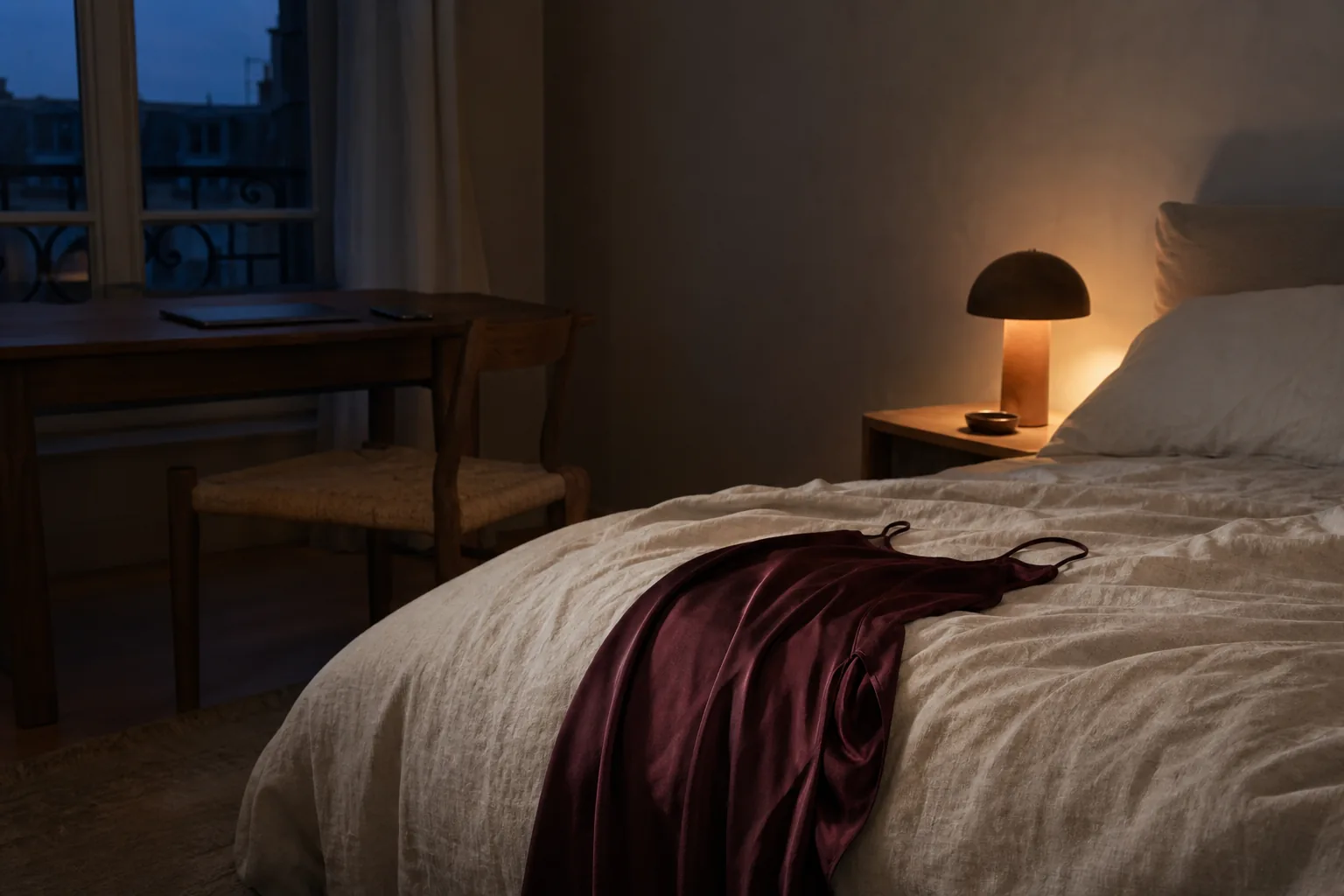
Turn off the overhead light and put on a small lamp instead. If you enjoy it, light a candle — not because you need one, but because a single flame in a dim room changes the way the space feels. Let the room be quiet, or put on music without lyrics. The aim is to lower the amount of sensory input your brain is processing, one channel at a time.

Even two quiet minutes can create a clearer boundary between work and the rest of the evening. It is not about buying new things. It is about using what you already have — a lamp, a corner of the sofa, a moment of quiet — to mark a quieter part of the evening.
Step 3: Do One Thing With Your Hands
After a day of thinking, a small physical task can be surprisingly grounding. Not something you should do. Something you can do without much thought.
Make a cup of tea and hold it with both hands. Fold a blanket. Water a plant. Turn a few pages of a book. Write three lines in a notebook — not a journal entry, just three things that happened today. The bar is low on purpose. This is not productivity. This is giving your hands something to do while your mind catches up to the fact that work is over.

If you find yourself reaching for your phone at this point, that is normal. The phone is a powerful distraction, and the silence of a quiet evening can feel unfamiliar at first. Try leaving it in another room for ten minutes. You can always go and get it later. After ten minutes, decide whether you want to bring it back.
For a shorter version of this step, our 20-minute after-work reset offers a condensed routine for evenings when time is tight.
Step 4: Be Still, Intentionally
This is the step most people skip, because sitting still without a screen feels uncomfortable at first. That discomfort is not a sign that you are doing it wrong. It is a sign that you have been running on output all day and your system has forgotten how to coast.
Sit somewhere comfortable. It does not matter where — a chair by the window, the end of the bed, the floor with a cushion. Do not try to meditate if that does not come naturally to you. Just sit. Look out of the window. Listen to the sound of the room. Let your shoulders drop.

If ten minutes of stillness feels like too much, start with three. If sitting still is genuinely difficult, try a slow, repetitive movement instead: brushing your hair, applying hand cream, walking slowly from one room to another. The aim is to be present in your own body without performing anything.
We have written more about adapting this practice on demanding days in a slow evening routine for women who are always on.
Step 5: Close the Evening Gently
The last step is the gentlest. As the evening draws to a close, do one small thing that signals rest. Wash your face. Step into something comfortable. Place your phone somewhere you cannot reach it from bed.
Changing out of work clothes can become a simple signal that the day has shifted. Choose something that feels easy against the body, whether that is a familiar cotton set or a softly draped piece such as the Nocturne Lace-Trim Lounge Dress. The point is not the garment itself. The point is the act of choosing it — of dressing for rest rather than for output.
Three Versions for Different Evenings
Some evenings you have forty-five minutes to yourself. Other evenings you have fifteen. The reset adapts to what you actually have, not what you wish you had.
The Fifteen-Minute Reset. Close your laptop (Step 1). Turn off the overhead light and put on a lamp (Step 2). Make tea and sit with it until it is finished (Steps 3 and 4 combined). That is it. Fifteen minutes, and you have drawn a line between the day and the evening.
The Full Reset. All five steps, roughly forty-five minutes. Take your time with each one. This works well on weeknights when you have no plans and want to protect the quiet.
The Extended Reset. Take the full framework and stretch it across a Sunday evening or a night when you have nowhere to be. Add a longer bath if that is your thing. Take an hour over a book. The structure holds; you just give each step more room to breathe.
If you want to go deeper on creating an intentionally calm home, read how to romanticise your evening at home-it is about small, low-cost changes that shift the feeling of a room.
Frequently Asked Questions
What is an evening reset?
An evening reset is a short, deliberate transition from work mode to rest mode. It uses sensory and physical cues — dim light, quiet, a change of clothes, a moment of stillness — to signal to your body that the working day has ended.
How long should an evening reset take?
Anywhere from fifteen to forty-five minutes, depending on how much time you have and how many of the steps you choose to do. The short version — close your laptop, dim the lights, sit with a cup of tea — takes under fifteen minutes and still makes a noticeable difference.
How is an evening reset different from a night routine?
A night routine usually focuses on hygiene and preparation for bed: washing your face, brushing your teeth, setting an alarm. An evening reset happens earlier and is about the psychological transition. It bridges the gap between finishing work and beginning the wind-down. Many people find that doing the reset first makes the night routine feel less like another set of tasks.
Do I need special products for an evening reset?
No. The reset uses what you already have: a lamp, a chair, a cup, a quiet corner. If you find it helpful to have something specific to change into, a simple satin lounge set can mark the transition without much thought. But the reset is a practice, not a purchase.
What if I share my home and cannot control the environment?
You do not need a silent house to do an evening reset. Wear headphones. Claim ten minutes in the bedroom while someone else watches television. Light your lamp in a corner of the room even if other lights are on. The reset is adaptable. What matters is the intention, not the perfect setting.
3 Responses